When people talk about sustainability in the construction industry, they usually think first of eco-friendly materials or new building technologies. Yet in some cases, the biggest impact can come from elsewhere: how processes are organized, the reuse strategy, or the ability to change the way things are done. The partnership between K inventory and Gyproc in the United Arab Emirates is a clear example of this alternative approach to sustainability.
A distant problem, a familiar solution
The idea behind this partnership came from a completely different sector. An international company had faced a major challenge: managing its IT equipment sustainably. More than 100,000 IT devices were involved: computers, servers, peripherals, network equipment. Faced with this complex problem, the organization did not try to reinvent the wheel or build a solution in-house.
Nor did they test several alternatives or run long and costly comparative studies. The company went straight to an existing solution, initially developed for other use cases, but whose core principles matched their needs perfectly. This pragmatic approach let them see benefits quickly, not only in equipment management but also in their ability to adopt a truly circular approach.
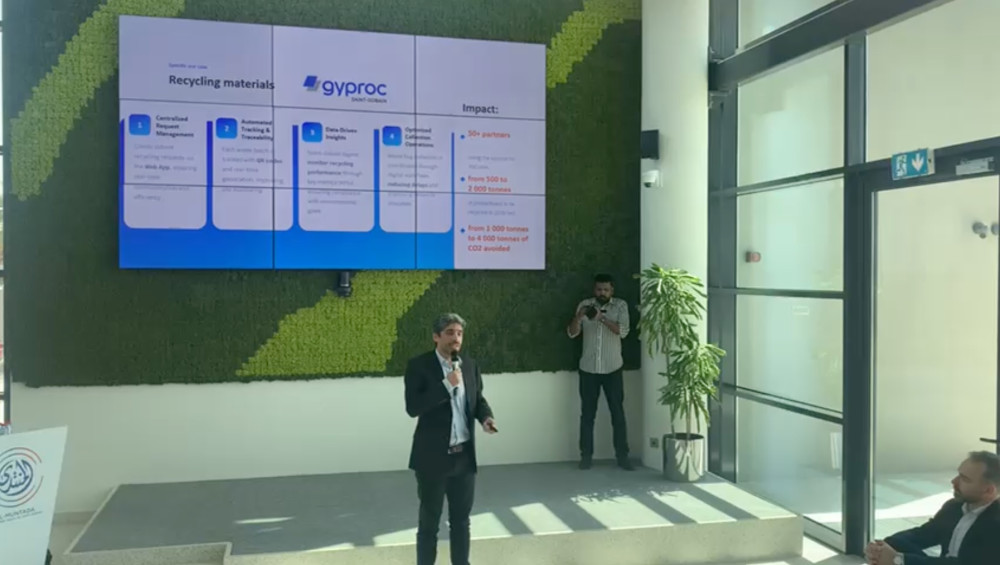
This is exactly the philosophy that brought K inventory and Gyproc UAE together. Rather than developing a custom management system for its building materials, Gyproc UAE chose to adopt the proven K inventory solution, initially designed for other sectors but easily adapted to the challenges of the construction industry.
A strategic lever for a practical circular economy
Thanks to this fast-adoption strategy, Gyproc UAE was able to transform its building materials inventory management. The company, which specializes in drywall solutions and is a subsidiary of the Saint-Gobain group, manages thousands of SKUs every day: standard and technical plasterboard, metal profiles, fixing accessories, insulation, and many other components essential to construction projects.
The parallel with the IT example is striking. Just as the technology company had extended the life of computers bought in 2019 by using them for three to four years and then reallocating them to other entities, Gyproc UAE set up a similar system for its building materials.
Plasterboard ordered for a high-end residential project in Dubai Marina can be reused on a commercial site in Abu Dhabi if it is not fully consumed. Surplus metal profiles from a hotel project in Sharjah get a second life in the construction of an education complex in Al Ain. This systematic reuse considerably extends the lifecycle of materials, well beyond their originally planned use. The approach is a direct application of the circular economy to the construction sector.
Full traceability for measurable performance
One of the most valuable lessons from the IT example was the ability to keep clear traceability of how equipment was used, right up to final recycling. This need for transparency has become a cornerstone of the K inventory x Gyproc UAE partnership.
With the K inventory digital platform, every material now has a complete digital identity. Gyproc UAE teams can follow the journey of each plasterboard in real time, from the factory to final installation, including any transfers and reallocations between sites.
This traceability lets the company show, with figures to back it up, that sustainability does not depend only on what materials are made of or where they come from, but also, and above all, on how well they are used. Gyproc UAE's environmental performance indicators have improved considerably, with a measurable reduction in the carbon footprint linked to transport and to purchases of new materials.
Automate and structure to build better with less
Another key lesson from the IT case concerns the efficiency that comes from automating repetitive tasks. By standardizing certain processes and relying on the right tools, the IT team had sharply reduced errors, cut time-consuming manual work and saved valuable time.
This productivity factor proved decisive for Gyproc UAE. The K inventory solution automated all inventory, ordering and material reallocation processes. Stock managers no longer need to manually record material movements between the company's different sites in the UAE. Automatic alerts prevent stockouts while avoiding overstock.
This automation helped them manage their supply chain better, and above all build a scalable approach that can easily be replicated in other MENA markets. The operational efficiency gained frees up time and resources for higher-value work: product innovation, customer relationships, business development. To see how this approach could apply to your sector, visit our page on all our industries.
Concrete, measurable results
Six months after implementing K inventory, the results of the partnership with Gyproc UAE speak for themselves. To measure this performance precisely, the company relies on inventory KPIs adapted specifically to the construction sector:
Environmental performance:
- 35% reduction in material waste on sites
- 25% fewer inter-site transports thanks to optimized flows
- Reuse rate of surplus materials reaching 78%
- 20% reduction in the carbon footprint linked to supply
Economic performance:
- 30% improvement in stock turnover
- 18% lower supply costs
- 22% less storage space needed
- 40% productivity gain for logistics teams
Operational performance:
- Full traceability of 100% of product SKUs
- Order processing time reduced by 45%
- Stock management error rate divided by 4
- Better customer satisfaction thanks to improved product availability
An inspiring model for the regional industry
The success of this partnership in the United Arab Emirates is now drawing the attention of other construction players in the Gulf region. Gyproc UAE's approach shows that it is possible to combine economic performance and environmental responsibility without compromising on quality or delivery times. This success clearly illustrates the economic benefits of responsible equipment management.
It also fits squarely with the sustainable development drive of the UAE Vision 2071, which aims to make the country the best in the world by 2071, particularly in innovation and sustainability.
In summary
This case, inspired by an approach proven in a completely different sector, shows that sustainability is not just a matter of choosing materials or adopting new technologies. It is above all a smart combination of strategy, effective digital tools and optimized processes.
By adopting a ready-to-use solution and methodically structuring its circular approach, Gyproc UAE was able to put a real circular economy model in place, with concrete and measurable results. This partnership with K inventory shows how French innovation can support the sustainability ambitions of international companies, creating shared value between operational efficiency and environmental responsibility.
The main lesson remains that sometimes the best innovation is not to reinvent the wheel, but to adapt existing solutions intelligently to new industry challenges. To find out how K inventory could transform the way you manage your materials, book a personalized demo.